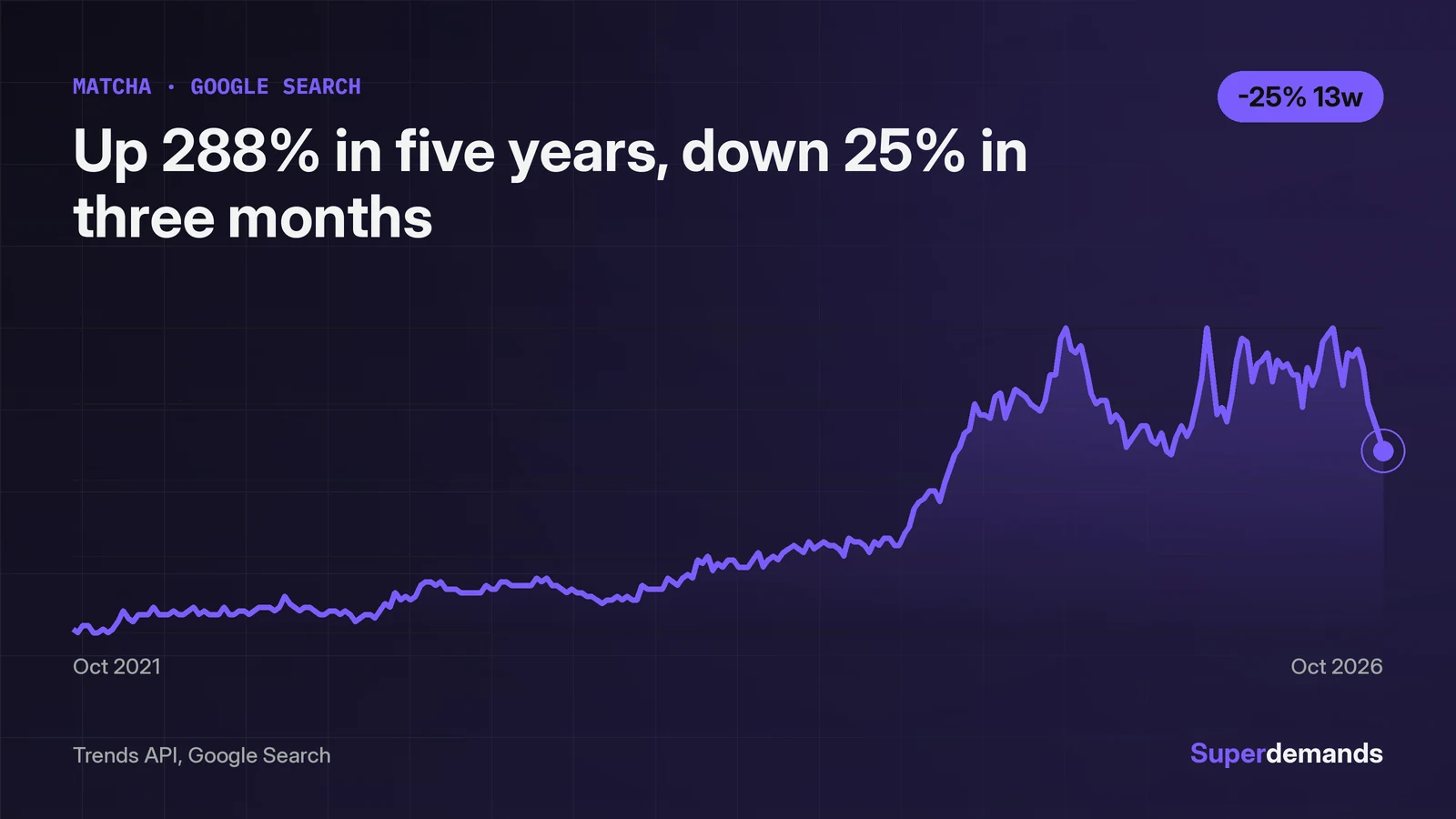
Matcha demand is real but cooling. Over five years of weekly Google Search data (261 points from October 2021 to October 2026), interest in matcha rose 288.24%, from an index of 17 to 66. The latest reading, 66 for the week of October 24, 2026, is down 25% from 88 three months earlier and down 10.81% from a year ago (74). The series first touched an index of 100 in the week of August 9, 2025, so the current move is a cooldown from the all-time peak, not a collapse: the index still sits 50 points above its November 2021 trough of 16. Google Ads Keyword Planner puts "matcha" at about 3.35 million monthly searches with HIGH competition. The honest read: demand is far above its 2021 base, the 2025 surge is deflating, and 2026 looks like a normalization year rather than a new baseline.
The five-year arc: from niche tea to a 2025 blow-off
The long-run chart tells one clean story: matcha moved from a niche interest to mainstream demand, and almost all of that move happened in the last three years.
Through 2022 the index barely moved, hovering between 19 and 26 after bottoming at 16 in the week of November 6, 2021. 2023 and 2024 were the steady build: mostly the high 20s in 2023, the 30s and 40s in 2024. 2025 was the breakout year. The index crossed 50 in the week of January 11, 2025, kept climbing through spring, and first hit 100 in the week of August 9, 2025. From the first point of the series (17, October 30, 2021) to the latest (66, October 24, 2026), growth is 288.24%.
The index mechanics are explained on the Google Trends demand guide, and the growth windows in this piece follow the methodology used across the site.
The last three months carry most of the cooldown
Nearly all of the year-over-year decline happened in the last three months.
The 12-month reading is a decline of 10.81% (74 in the week of October 25, 2025 to 66 now), but the three-month reading is a decline of 25% (88 in the week of July 25, 2026 to 66). The drop from the all-time 100 is 34 index points over about fourteen months. Part of this looks seasonal: matcha has peaked in summer before (100 in August 2025, 96 to 100 across the first three weeks of August 2026) and softened in winter (the mid-60s to low-70s from November 2025 into January 2026). The current 66 sits close to those normal winter levels, which suggests some of the three-month slide is the ordinary autumn fade rather than structural decline. This is a suggestion, not a verdict: the series has also produced non-summer peaks, including a 100 reading in the week of February 21, 2026.
Volume is huge, and the ad auction is crowded
Demand is not the problem; competition for it is.
Google Ads Keyword Planner puts "matcha" at roughly 3.35 million monthly searches, with competition rated HIGH. That makes it a mass-market query, and advertisers already fight over it. For sellers, this means the cost of reaching matcha searchers reflects the interest: the margin for error is thinner here than in a quiet niche, so the decision is less "is there demand" and more "can you acquire it profitably."
What a seller should watch before buying in
Treat 2026 as a normalization year: not a floor, not a ceiling.
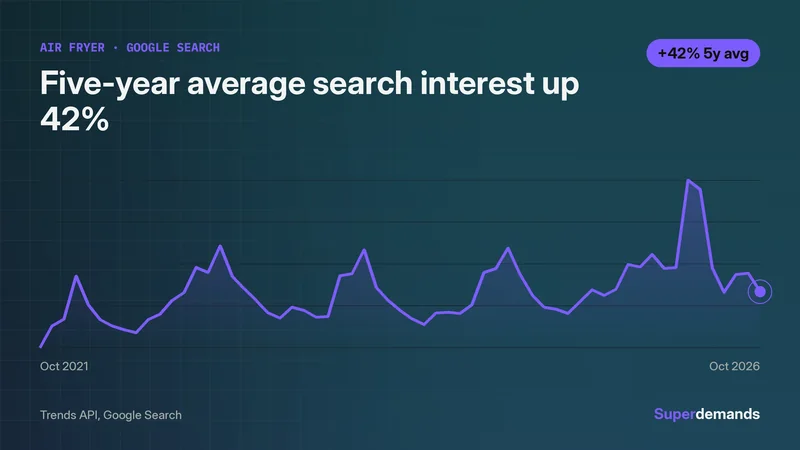
First, whether the index holds above 60 through the winter of 2026 to 2027. Each cycle's floor has risen (the trough was 16 in 2021, winters in 2023 sat in the mid-20s, winters in 2025 to 2026 in the mid-60s to low-70s), and a break below 60 would be the first real sign of structural decline. Second, whether spring 2027 retests the highs. Three touches of 100 (August 2025, February 2026, August 2026) show the ceiling is repeatable; a failed retest would signal the blow-off is over. For a contrast, the five-year air fryer demand story shows a category that grew steadily without a peak at all. More food and drink demand reads cover neighboring categories.
The honest caveat: this is search interest, not sales, and no series on this page can say how much of the 3.35 million monthly searches is buying intent versus curiosity.