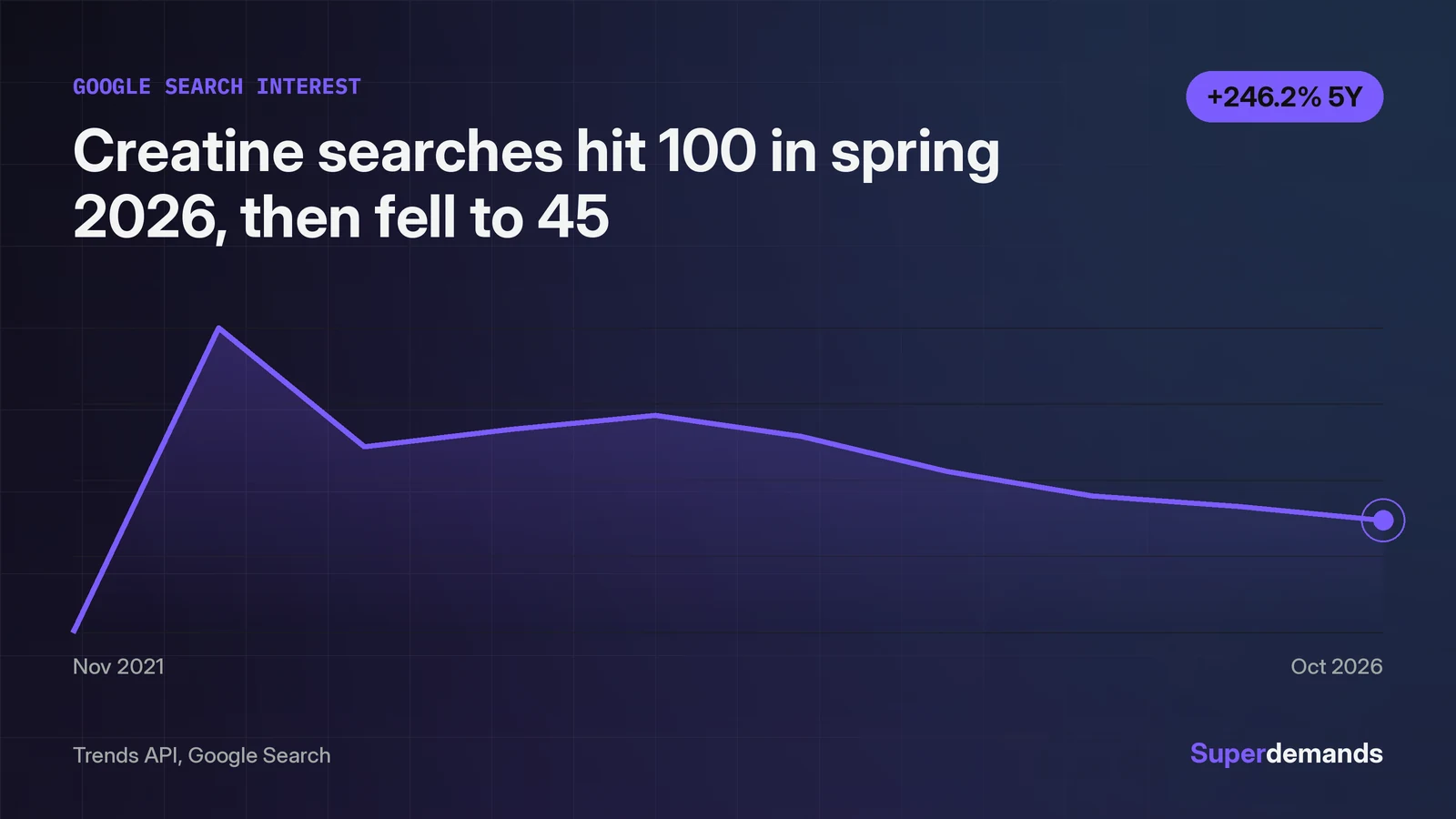
The latest weekly reading for creatine is 45 out of 100, for the week ending 31 October 2026. That is a long way below the spring peak of 100 on 11 April, and 38.4% below the level three months earlier, yet it is still more than three times the level at the start of the record. The yearly average rose in each of the five years, from 14.2 in 2021 to 73.9 in 2026, a five-year change of 246.2%. Amazon buying demand, meanwhile, rose 11.9% over 12 months while Google search fell 16.7% over the same span. One measurement note matters before the numbers: the exact phrase "creatine demand" is too small for Keyword Planner to report, so this piece tracks searches for "creatine" itself, and the volumes quoted are estimates derived from the index rather than counted searches.
Each yearly average beat the one before it
The Google series runs 261 weekly points, from 6 November 2021 to 31 October 2026. It opened at 13 and closes, for now, at 45. Between those two points the yearly averages climbed without a single down year:
| Year | Average index |
|---|---|
| 2021 | 14.2 |
| 2022 | 22.0 |
| 2023 | 25.6 |
| 2024 | 31.6 |
| 2025 | 50.0 |
| 2026 | 73.9 |
The 2026 average is 5.2 times the 2021 average. The climb also accelerated near the end: the average rose 58.2% from 2024 to 2025, then 47.8% from 2025 to 2026. The 2026 figure covers the year to 31 October only; November and December are not yet in the record. Keyword Planner puts "creatine" at 2,240,000 searches a month with HIGH competition, a volume that fits a term which has moved from a niche supplement word to a mainstream search. The mechanics of the 0 to 100 index are set out in how the index is built, and nearby health topics sit in the health category.
The spring peak towered over every earlier year
Spring 2026 produced the highest creatine interest in the five-year record. The index reached 100 in the week of 11 April 2026, and seven weeks in the record reached 90 or above. No earlier year averaged close to that height: the 2025 yearly average was 50.0, exactly half the peak value.
Nothing in a search series explains why a surge happened. New buyers, new products, price changes, or something else entirely could sit behind the spring numbers, and the data cannot choose between them. What the data can say is that the peak arrived after five years of rising yearly averages rather than out of a flat stretch. A high point reached from a rising base carries a different meaning from a high point reached from nowhere, and creatine is the first kind.
Autumn gave back more than half the peak
The slide from the spring peak has been steep and orderly. Google search interest fell 55.0% from 100 on 11 April 2026 to 45 on 31 October, and 38.4% in three months, from 73 to 45. The last eight weeks trace the shape:
| Week ending | Index |
|---|---|
| 12 September | 66 |
| 19 September | 71 |
| 26 September | 75 |
| 3 October | 69 |
| 10 October | 59 |
| 17 October | 52 |
| 24 October | 49 |
| 31 October | 45 |
Interest rose for two weeks in September, then dropped five weeks running, down 31.8% from 12 September to 31 October and 40.0% from the late September high of 75. The 12-month change is down 16.7%, from 54 to 45, so the current level sits below the same point last year as well as below the spring peak. A fall this steady across eight weeks is harder to dismiss as noise than one low week, but a steady fall still does not by itself prove the five-year climb has turned.
Amazon buyers held their level
Amazon points the other way from Google. Amazon search volume for creatine is up 11.9% over 12 months, from an index of 77.3 to 86.5, with estimated volume rising from 6,607,659 to 7,392,129 searches. Over three months it is essentially flat, up 0.5% from 86.1 to 86.5, with estimated volume rising from 7,357,738 to 7,392,129. Buying demand, in other words, kept its level while Google search fell by more than a third.
Google and Amazon count different behaviour: typed questions on Google against searches inside a store where the next step is a purchase. The numbers show a split between the two, and they do not explain it. One possible reading is that people who already buy creatine kept buying through autumn while casual curiosity cooled, but that is a suggestion rather than a finding, and it would need sales data to confirm. The Amazon record begins 31 July 2022, so it cannot show a five-year window. Readers tracking nearby shopping topics can compare with the shopping category.
YouTube cooled too, from a lower starting point
YouTube search interest in creatine moved in the same direction as Google, from a lower base. On YouTube, interest is down 8.1% over 12 months, from 62 to 57, and down 18.6% over three months, from 70 to 57. Over five years it is still up 137.5%, from 24 to 57. Every window closes on 31 October 2026, matching the Google figures, so the three sources line up on the same date.
YouTube lands between the other two sources: a five-year climb in the same direction as Google's, though smaller in percentage terms, a recent fall about half the size of Google's three-month drop, and none of the flat buying demand Amazon shows. Video search sits between plain search and shopping, and the figures land in between as well. The Google Trends demand data behind these figures explains how the index is built across sources.
Durable interest, unproven growth
Interest has lasted; growth has not yet proven it will. Five years of Google search point up 246.2%, yet the index has fallen 55.0% from its spring peak and sits below its level a year ago. Amazon volume is up 11.9% over 12 months, and YouTube interest is up 137.5% over five years while down over 12 months and three months. The three sources do not agree on a single direction, and that disagreement is the finding.
Three limits belong with it. Search interest measures attention, not purchases: nothing in this piece counts units sold or shipped. Volume figures here are index-based estimates, not counted searches. The Amazon record begins 31 July 2022, giving it roughly four years against Google's five. The next spring decides it: a return toward the 90s in spring 2027 would point to a higher plateau for 2026, while a peak near 60 would mark 2026 as the high point of the climb.